


There’s something so right about showing up at a 10:25 am matinee showing, in my sweatpants with my snot-covered sleeves—because I was too lazy to get up and search for the tissues. I was looking really gross is what I mean. Out and about in my pajamas, unshowered, hair frizzy, just to see the opening day of How Do You Know with Reese Witherspoon, Paul Rudd, Owen Wilson, and Jack Nicholson.
Quickie synopsis from IMDB: Feeling a bit past her prime at 27, former athlete Lisa Jorgenson finds herself in the middle of a love triangle, as a corporate guy in crisis competes with Lisa’s current, baseball-playing beau.
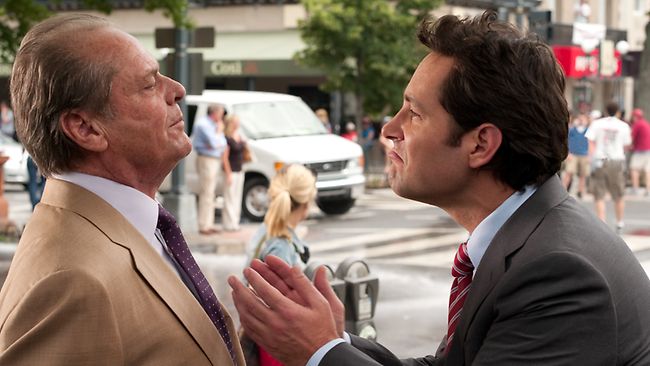
I don’t know if it was because the theater was empty, or if it was just the on-screen chemistry, or if the characters themselves were supposed to be awkward, but some of the scenes, particularly between Paul Rudd and Jack Nicholson, felt really off. As if they worked better in the trailer, out of context, than they did in the film. No way was this all the work of James L. Brooks.
Most of the scenes between Paul Rudd, the corporate guy in trouble, and Jack Nicholson, the screaming father who owns the company, felt empty, as if the adored men before us were simply actors reciting lines. I couldn’t be immersed in the Jack/Paul storyline because, perhaps, the story itself felt manufactured. It felt like Brooks was throwing obstacles into the formula, upping the stakes, but that’s all these scenes felt like, obstacles. It was as if that very storyline could have been replaced with a handful of others, swapped in and out interchangeably. The reason it didn’t matter what the story was is because I didn’t believe the relationship. I wasn’t convinced of the father son story between Jack and Paul. I didn’t hate Jack the way Annie (the wonderful Kathryn Hahn who played -again- the pregnant woman in HBO’s Hung) hated him, to the point where she almost strikes him. And I wanted to. I really wanted to hate Jack. But the film’s manipulation of our affections was too heavy-handed. Having an emotional pregnant woman nearly punch Jack, really? Do we all need to be hit over the head with it? I have no reason to hate him. And maybe that’s because Jack Nicholson brings too much history to his role. We expect him to be crass and abusive, so when he is, it’s no big shock. We’ve already learned to tolerate him that way. I wanted to hate him, but I wasn’t given the opportunity to care, really care, about his son George (Paul Rudd) before Jack got all abusive on his ass. I wish we could’ve hated Jack with a smaller gesture. Not a punch to the head by a sweet prego mama but in a smaller moment, when perhaps, he steals someone’s parking spot, or neglects to open a door or hold an elevator… or my personal favorite, when someone saves up all their money to buy him something special and he insults the gift. That’s an immediate hate- cliched, but locked and loaded. So, no, when it came to the father/son storyline, I simply didn’t care.
But there was a lot I did care about. There were a lot of good language moments, and moments where I found myself laughing out loud in such a genuine way, and you know it’s genuine because no one else is in the theater, so it can’t be conformity laughing. I loved the heart of it, the uniqueness of some of the scenes. In particular, an early moment when Reese Witherspoon’s character suffers from a setback, we don’t see her emotions until she’s brushing her teeth. It’s there, staring at her reflection that tears mingle with toothpaste. And we’re shown who she is, the type of character, by the self-help post-it notes affixed to her mirror, her mantras. I wanted those same details about Jack, to be shown why we should hate and understand him.
SLIGHT SPOILER: I loved the scene where George (Rudd) filmed and re-filmed the proposal to his friend. See, now that, that scene was original. I adored it. It was the best scene of the whole film.
The big thoughts of the picture: you want someone to love you the way you are. And not want to change you or make you love yourself in a different way. You should love the things you love about yourself, and find someone who interprets your bad shit as adorable shit.
Also, I love when people get gifts in movies because there’s so much expectation and story behind a gift.
I didn’t love the Owen Wilson character as the baseball player. And I didn’t love all the softball team stuff in general. I just didn’t care about any of them. They had these small parts that kept being roped in, but nothing happens with it, and the softball storyline never really pays off. You take the roll as the softball friend, because, come on, who’s going to turn down anything with a Paul Rudd, Reese Witherspoon, Jack Nicholson, James L. Brooks film? I mean, come on. But, you kinda should’ve.
And why include the “almost going to therapy” scene where Reese’s character is told to know what you want and figure out how to ask for it. Love the advise, but why would it come from a therapist and not one of her softball friends? Why add this scene into the film?
Basically, I liked the film in a vacuum, between Reese and Rudd only. Paul Rudd as George says it best, about how we’re all one small adjustment away from our lives finally making sense and coming together. And that’s what Reese’s character needed to hear from him, so she could understand that despite her softball setback, things would fall into place for her, too.
I would see it again, but just for the Reese Rudd scenes. The rest, I know, I could do without.

I absolutely love going to the movies by myself – the matinee where you can throw on a baseball cap and slunch in your jammies – the best! Thank you for the review…maybe I’ll miss it. But I am interested in what you think of Black Swan.
I had a baseball cap/jammie moment the other day…and was riveted – fascinated – horrified – transfixed, and I left…changed. I think that’s my favorite kind of movie – one that changes you.
A few years ago, on a dark, foggy afternoon, I went by myself to see ‘Monster’ with Charlize Theron. Scared the absolute shit out of me…I left changed. Loved every moment.
Yeah, this movie sucks. I really expected more from such a good cast, but I thought Paul Rudd wasn’t even likable. I didn’t like his awkwardness, it seemed almost disturbing. Reese Witherspoon is kinda always the same to me. Regardless, I enjoy her acting. Jack Nicholson’s talent was wasted in this film, and I didn’t think there was much of a point for his character. Owen Wilson generally annoys me, so that’s no surprise there, but I didn’t HATE watching him.
There were a couple funny parts, but I was pretty surprised by just how bad this film was. Another case of one good actor luring in other good actors to come onboard instead of the actual script being the bait.
It appears that this blog just might turn into a holiday season movie review. I will jump on board while there is still time before you hit the “closed for comments” button.
Felt the same about your comments on How Do You Know. I shoulda known before I spent the after matinee bucks that this film was probably not so hot. I do love Reese and of course, Jack but Owen, hmmm. He has some kind of pull-you-in charisma that I cannot describe. I don’t really think he is a good actor but you hafta admit the line up of actors should have made it more interesting.
On another recent viewing…Black Swan. Wow. It totally engaged me and left me with a thought provoking afternoon. It’s one of those films that you must see at least twice just to pick up the symbolisms that you missed the first go around. Have great holiday, Stephanie and also to your bloggers.
“moments where I found myself laughing out loud in such a genuine way, and you know it’s genuine because no one else is in the theater, so it can’t be conformity laughing.”
I know what you mean — I went to see The Tourist the other day, even though I could tell from the trailer it wouldn’t be amazing, but it was the first film in a while I’ve laughed so hard and so genuinely at.
Sometimes a movie can be not really a good movie overall, but you can still enjoy the hell out of it. Which sort of works too.