

First, since you’ve all asked. Here’s a link to my favorite ketogenic cookbook.
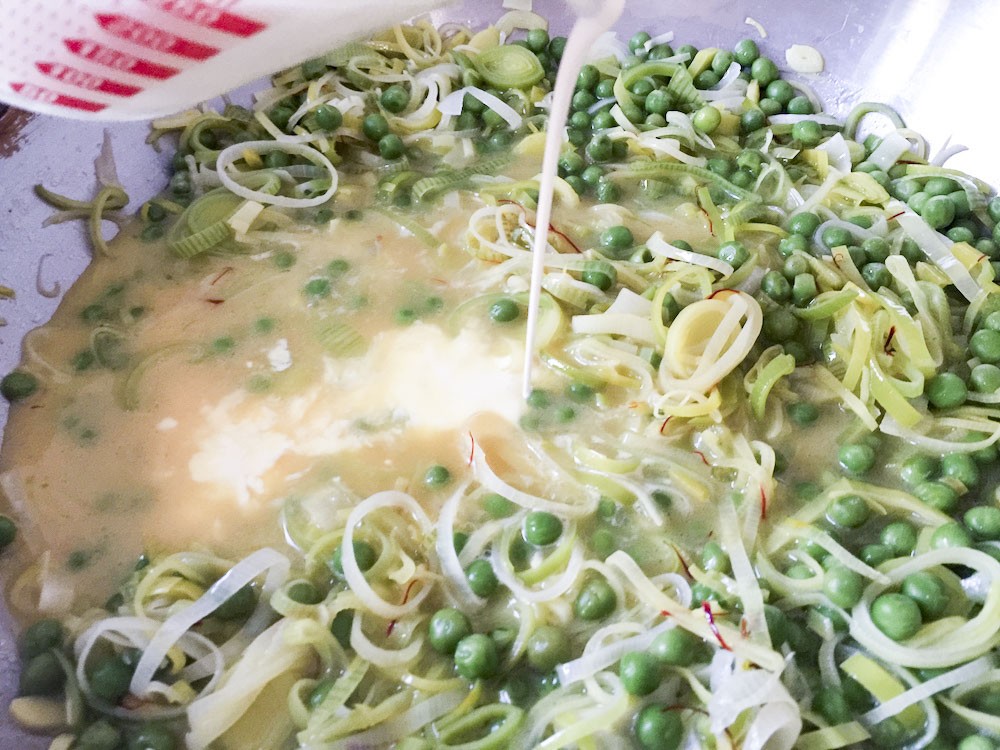
I do not eat peas, so before I added the peas to the leek, peas, saffron and cream sauce, I set aside a portion for myself. I’d like to say I smothered the creamy butter sauce over some chicken thighs, but I did not. I likely ate it straight from the pan, right off the wooden spoon. I can’t remember because I was in a food haze of love. Yes, I still want to bed down food and have my way with it, but now it’s my way, not Oh, God, look at what I weigh.
I began my “no sugar added” adventure on January 12, about 8 weeks ago. As for sugar, the only kind I’ve ingested is the sugar found in 1 cup of berries (raspberries 5 g, blackberries 7 g, blueberries 15 g, strawberries 7 g), and the sugar found in asparagus (2.5 g in 1 cup) and sometimes in wine (0.9 g in 5oz.), and regularly in my stevia-sweetened Lily Bars. Do I count how many grams of sugar I have daily? No. But at first, when I was desperate to lose weight, I kept track of all my macro-nutrients using the free app MyFitnessPal [I modified the app (followed instructions), then once I installed the javascript, I was able to login to MyFitnessPal, select ‘goals,’ edit ‘Daily Nutrition Goals’ and set them to: 5% Carbs, 30% Protein, and 65% Fat]. If you read that last technical bit, your eyes must’ve widened. Holy, hell. 65% of her diet is fat? Yes, yes it is. My goal is to stick at or under 20 g of carbs a day. This is considered a Ketogenic Diet, or Keto, as it puts your body into a state of ketosis. Ketosis is a normal metabolic process, something your body does to keep functioning. When your body doesn’t get enough carbohydrates from food for your cells to burn for energy, it burns your fat instead. As part of this process, it produces ketones, and you can check that you’re body is actually producing these ketones with an accurate blood test, or with the less accurate, but much more useful and monetarily affordable, urine strips.
When I first started, I felt like I must’ve had the flu. They call it “keto flu,” when your body goes from burning carbs for energy to burning fat for energy. I felt like shit; it’s no lie. And the best advice I can give is “DO NOT FEAR FAT. IT WILL NOT MAKE YOU FAT.” UNLESS… you also eat sugar. If you eat sugar and fat, expect to soon resemble a doughnut.
 Above, ingredients for Braised Lamb Chops. The recipe from Anne Burrell’s Cook Like a Rock Star

While it’s not “Keto compliant” exactly, Anne Burrell’s recipe for Braised Lamb Chops is close enough (recipe below). I mostly ate the lamb and enjoyed a smaller portion of the browned soffritto (basically pureed vegetables). I should’ve made a shit pile more lamb. It’s my favorite meat. It actually would’ve been better without the apple; my whole family agreed.
People want to know, “So, like, what does a typical day look like?” As I live today, I’ll update this post and include everything I eat. This is what I’ve eaten today, so far. Some mornings I’m hungrier, and I’ll devour full-fat cheese, whole eggs (not whites only!) with a sliced half of avocado, heavy cream in my coffee or tea. Bacon if I’m ambitious.

I’m not going to pretend that I’m an expert (so please check with your doctor before starting any weight loss or exercise program), or that I’ve been perfect (my ratios aren’t always what they should be). But I will tell you this: it’s been alarmingly easy. The best part, and I’d never thought I’d say this, is that I’m not even tempted to eat sweets. I’m not repulsed by them or anything, but I can easily bake for the kids now (they need to gain weight) without licking my fingers or tasting the finished product. I know myself and don’t want to open those floodgates. I’ve been baking from Christina Tosi’s Milk books (Her key ingredient to amazing cookies? The addition of non-fat milk powder).
Last night, I devoured a butter-fried New York Strip steak with Boursin cheese and pan seared asparagus with hollandaise sauce. Other nights it’s shrimp scampi (sans bread crumbs) with burnt broccoli. Tuna tartare. Crunchy grilled chicken thighs with the skin. Zucchini noodles with carbonara sauce (eggs, cheese, bacon, and black pepper). Loaded cauliflower casserole (bacon, chives, cream cheese, cheddar, sour cream). Cowboy chili with sour cream and scallions. You get the drift. Tonight, I’m making meatballs and spaghetti for the kids and Phil. My version won’t have breadcrumbs but will have fresh, no sugar added, tomato sauce. On occasion, I will hasselback a sweet potato, rub it in bacon fat and shower it with salt, minced garlic, and thyme, roasted for 50 minutes at 425 degrees. I probably eat 3 whole sweet potatoes. Not good, but again, floodgates.

When the scale doesn’t move and I’ve been “so good,” I cut back on the dairy, and the weight slips right off. I love my full-fat dairy (heavy cream has 0 carbs), especially since I get no sugar! But, if you really want to cut the weight fast, cut the dairy, too. I, however, could never sustain this without my dairy. I’d feel way too deprived. But it’s hard to feel deprived eating garlic parmesan smothered wings.
Eating this way, I’ve eliminated most processed foods (save for some cheeses). When I feel “snacky,” I grab a Bel Gioioso Fresh Mozzarella 70 calorie snack pack (sold at Costco), or eat some smoked salmon, or grab a few nuts, or eat some berries, or eat half an avocado with Maldon salt. I don’t count calories, but since they show up on MyFitnessPal, I generally eat 1200 calories a day.
I purchased a Withings Scale, which doesn’t just automatically add my weight to MyFitnessPal progress chart (and to my cell phone), but it also gives me a body fat reading (since that’s all I actually care about). I love the ease of it. How accurate are the body fat readings? I don’t think they’re very accurate, and have a feeling it changes based on how hydrated you are, but it does give me an overall set point, so I have a general idea of what’s going on.
Over the past 8 weeks, I’ve lost 16 lbs., and for once I know that I’m losing fat, not muscle or water weight. That does average to the safe “2 lbs. a week” suggestion, which is frustrating if you want to see the weight “melt off.” If you cut out the dairy and don’t eat too many nuts, you’ll lose it a lot faster than I have. I feel much healthier and leaner, and I feel like I could genuinely stick with this forever. When you know it’s working, you don’t want to get in your own way. And when I head out to one of our favorite restaurants, I still enjoy eating the entire bowl of panna cotta and two glasses of wine, but the next day, I’m 100% back on. I think once you cut the sugar, the urge to binge is curbed.
Recipe: Braised Lamb Shanks, from Anne Burrell’s Cook Like A Rockstar
4 lamb shanks
Kosher salt
Extra virgin olive oil
2 onions, coarsely chopped
4 carrots, coarsely chopped
4 celery ribs, coarsely chopped
4 cloves garlic, smashed
1 cup tomato paste
2 cups red wine
2 tablespoons fresh rosemary, finely chopped
4 bay leaves
1 thyme bundle, tied with butcher’s twine
1 Preheat the oven to 400˚F.
2 Season the lamb generously with salt. Coat a large sauté pan with olive oil and bring to medium-high heat. Add the lamb to the pan and brown well on all sides; this may take up to 20 minutes. This is an incredibly important step—it’s where all the big brown flavors start to develop—DON’T rush it.
3 While the lamb is browning, put the onions, carrots, celery, and garlic in a food processor and purée to a coarse paste; reserve.
4 When the lamb shanks are very brown on all sides, remove them from the pan and transfer to a roasting pan. Ditch the fat, add a bit of fresh olive oil to the sauté pan, and add the puréed veggies. Season generously with salt, and cook until the veggies are very brown and a crud has formed on the bottom of the pan, 8 to 10 minutes. Scrape the crud and let it reform. Don’t rush this step.
5 Add the tomato paste and cook, stirring frequently, until it starts to brown, 1 to 2 minutes.
6 Add the wine, bring it to a boil, and stir frequently to scrape the crud from the bottom of the pan (this is the big-money flavor). Continue cooking until reduced by half, 3 to 4 minutes.
7 Add 3 to 4 cups water to the pan and stir to loosen the mixture. Taste to make sure it’s delicious and re-season if needed. It will by no means be done, but it should taste good. Pour this over the shanks in the roasting pan. The liquid should come two-thirds of the way up the shanks; if it doesn’t add more water. Toss in the rosemary, bay leaves, and thyme bundle, cover with aluminum foil, and cook in the oven for 2½ to 3 hours. Check the shanks every 45 minutes, turn them, and if the liquid has reduced significantly, add more water. When the meat is done, it will be very tender but not falling off the bone.
8 Remove the foil for the last 30 minutes of cooking time for maximum browning and to allow the liquid to reduce and thicken up. Serve with lots of sauce.
Post contains some affiliate links


Happy to hear but your hair girl…DAMN! Tell us everything.
Aww, you’re too kind. Well, not “too” kind. Just enough kind. Thank you. The hair is so easy. I made a video about the hair ages ago. Here’s the link to the video. Curling Iron and Beautifying Oil.
Yes to all of this!
This is great! I’m so happy you’ve found the key to healthy eating and living – cutting out the sugar!!!
Good for you. Glad it’s going well.
I’m trying to cut just added sugar right now and it’s not so much that I crave it, but when I see it I have amnesia and somehow forget I’m trying to avoid it. Snacks are my biggest issue. I’m eating lots of popcorn and hummus but blah.
No, no, you don’t get off that easy, we need the whole makeup list, seriously, wow!
Okay, on Monday I will post a full list of makeup products used! (and Thank You!)
I totally second this. Those lashes, damn.
I’ve been reading you for years, so I’m glad you found something that works. I realize I’m a Debbie Downer, but I have to ask, have you said “This is so easy, I can stick with it forever” in regards to any other diet plan? 8 weeks is an achievement, no doubt. But 8 weeks does not make a lifetime. I hesitate to make this comment because its negative in the face of success. And I love it when you share details of your life. But from where I am sitting, I just can’t help but wonder if that’s a bit premature to say.
I value your caution, and time will tell. I will also say that for the first time ever, I’m doing this for my health (knowing that the fat is good for my brain). I worried that I’d become pre-diabetic with all the sugar I consumed. I feel like I’m finally doing what’s best for my overall health! Also, I love that you took the time to stand up and raise that flag!
Firstly, long-time reader (like, before the NYT article!): So glad to hear that you’re making changes that are increasing your health overall. Good for you! Big accomplishment! Secondly, TALK to me about that mascara! Your LASHES. Love!
You totally just made me laugh out loud. I’ll be posting a beauty products list on Monday, promise!
So, is the key to this ultra-low carbs, and very minimal sugar? I’m currently carrying around about 20 extra pounds, which is doing terrible things to my self esteem, but I LOVE food and I hate the idea of measuring and feeling deprived; what you’re doing sounds incredibly amazing! How long did the “keto flu” last? Sorry for the 20 questions…
Also, you look freaking gorgeous.
I really think the key is killing the sugar, limiting those carbs, and taking in a shitload of fat. The fat kills your appetite! You don’t even want to look at food. But you have to introduce the fat in slowly, because too much too soon gave me ‘rhea AND I felt like heaving. The “keto flu” doesn’t always happen. It helps if you consume lots of salt in those 3 days it takes your body to switch from burning carbs for energy to burning fat for energy. It’s incredibly easy to follow once you’re “in it.” Your body switches into ketosis mode fastest when you consume coconut oil or mct oil. I’m sure you’ve heard of Bulletproof Coffee, which is basically coffee with melted grass-fed butter and mct oil. I despise coconut, but I love coconut oil (except it gets sickening/boring after a while because it’s so flavorful). I was in keto flu for 3 days, maybe 2. I felt like a couch. I promise you I don’t feel deprived at all. But if I also had to quit dairy, I don’t think I could do it. That’s me though.
Oh, and anyone can look gorgeous behind a blurred filter, but thank you!
You should look for Jarrow Coconut Oil with the neutral taste — it is available on Amazon and you will not taste anything coconutty!
Would love to see more of your keto dinner recipes! I’ve been doing keto for the past two weeks as well, but menu planning for a family of four has been challenging. Even more, I would love to see a menu plan if you’ve been doing that for yourself!
Tonight I took ground beef and pork, added fine chop of onion, minced garlic, nutmeg, salt, pepper, thyme, parmesan cheese to all in a bowl, mixed it with my hands, then split the batch in half. I then added to each bowl 2 egg yolks and 1 whole egg. To my bowl, I added coconut flour to thicken. To “their bowl” I added a blob of ketchup and Italian-seasoned breadcrumbs. Mix mix mix. I then made meatballs, rolling theirs in panko crumbs. I fried up mine first (in beef fat I’d saved from making grass-fed bone broth), then drained fat and removed half my meatballs and added 1/4 c (I didn’t measure) Rao’s vodka sauce to the pan and remaining balls (Rao’s brand has no sugar added). Cooked to coat in sauce, added to bowl with grated parm and fresh basil. With my other half of balls, I coated in a mushroom cream sauce by Urbani. For kids, I added their balls to semolina hero bread, and they had meatball subs with fresh melted mozz.
Also sorry to be a Debbie Downer, but the Keto diet can be dangerous and should ONLY be done under medical supervision. Please be careful and talk to a doctor!
Love Keto.
I know I need to get back into it it’s when I feel at my best.
It kills my appetite and I have unbelievable energy.
And cream and cheese and and and
Yaaaay, my keto sister! I’ve been doing keto/Atkins too since the last time you posted about changing your diet and I’m almost down 20 lbs since about the same time you started. It IS easy now, but it wasn’t at first, and I have found new ways to enjoy the things I used to love. Keto waffles are a godsend when I want pizza. Also, check out Moon Cheese, which is dehydrated cheese balls (100% cheese) when you want something crunchy. Riced cauliflower is good rice substitute for stir fry/Asian dishes. Use almond and coconut flour to make pie crusts for cheesecakes (which is also very low carb if you use Stevia or Splenda). Bulletproof coffee in the morning is so yummy!
It’s just a different way of looking at food. But let me warn you, if you do decide to indulge in something special, the carb cravings afterwards are a b*tch for a day or so until you get back on track. I had more than my usual share of 1-2 glasses of wine this past weekend, plus some last night, so I’m feeling it today!
Oh also, check out all the yummy Keto recipes at http://www.ruledme.com This website helped me to understand what Keto is, and how to start.
I downloaded all their recipe books and used them regularly, plus if you do a search for “keto” or “low carb recipes” in Pinterest, you’ll find a lot of good stuff.
Dinner tonight is roasted leg-of-lamb with tomato caponata and sauteed green beans. Yum!
I tried all fat and protein. I lost a bunch of weight. Then, when the season changed and fresh fruit was growing in my garden, I tried to return to a normal balance of food. Oh boy! I GAINED weight – ridiculously and fast – and I’m not saying I went crazy on sugar or ice cream or anything! It completely changed my metabolism…in my case not for the better.
I have struggled my whole adult life to be an “ideal” weight. Diets work for a while – then they don’t. Finally, finally I have found peace with my body. It is plumper than when I was a kid, but hell – I’m not a kid. I am calm and accepting and serene about it, and that confidence is much sexier than a bony butt (I’m told often by my adoring lovah).
I worry about what we’re teaching our daughters, and what we’re reinforcing in each other. Why the obsession with weight? I heard an incredible story the other day on To the Best of our Knowledge – here’s the link if you care to have a listen. http://www.ttbook.org/listen/85706
Dear Stephanie, I am happy for you. I did the same thing last summer and lost 17 pounds between July 7th and the end of August. I am 59 and my cardio started talking about glucose levels. I weighed around 157 and got down to 139. I basically ate raisin bran, coffee, apples, cheese sticks, salami, and lots and lots of veggies, fish, chicken. My main problem in the beginning was finding something to replace juice. I was also walking 30-45 minutes every evening after dinner. I gained 5 pounds over the winter, but I am back on it since last Saturday and have lost 4 pounds already. Basically get rid of the bread, rice, sugar, juice, candy. I feel so much better – and I forgot to mention when I had my blood work done in September all numbers were where they should be. My triglycerides dropped 70 points. I love to bake but I like feeling great better. I know you already know all of this, but I am hoping to convince more of your readers. It was easy and every time someone told me they could not do it I was motivated yet again. YOU ALL can do this. Oh and i found those coconut Macaroons from Hail Merry with the strawberries in them – a great sweet treat without sugar. I am going to try to drop to 130-135 by the summer and stay there. Best, Carol
Great post – you look terrific!
I’d love to know how you got started. It sounds like you are following some kind of plan/book? Or did you literally just make it up, lol?
If there’s a website or book you’d suggest for someone interested in Keto, please pass that along.
Thanks and great job!
Thanks, J. I haven’t used a book to follow it. I use keto cookbooks for ideas on how to mix things up and try new meal ideas. Look here for the basics.
Hi Stephanie! Do you have a recipe for the cauliflower casserole? I’m on a Keto diet as well and it sounds amazing! Thank you.
I just made it this morning!
I take 2 heads of cauliflower, cut into florets, then steam (I use steamer bags in microwave – 4 min on high – for no cleanup).
In a glass casserole dish with a lid, I add one block of full fat cream cheese, then add cooked cauliflower to the casserole dish and mash it all together with masher.
I then add 5 chopped scallions, black pepper to taste, and 1 cup full fat sour cream–all to the casserole dish.
Then I add shredded cheddar cheese, again to taste. You can’t over-do it. Taste as you go.
If you’re a bacon lover, fry up some bacon, then crumble it into casserole dish (reserve some bacon). Mix up and cover with more grated cheese. All of this can be done in advance. When dinner time approaches…
Bake with the lid on at 350 F for 25 minutes. Remove lid and back for another 5-10 min until top is golden and bubbly. Then I add fresh scallions and the reserved crumbled crunchy bacon to the top, serve and say “You’re so welcome. I know right?”
You can also add butter if you need more fat. It’s fricken delicious!