

The Synopsis: When late-twenties Margot meets Daniel, their chemistry is intense and immediate. But Margot suppresses the sudden attraction: she is happily married to Lou, a celebrated cookbook writer. When Margot learns that Daniel lives across the street from them, the certainty about her domestic life shatters. She and Daniel steal moments throughout the steaming Toronto summer, their eroticism heightened by their restraint. Margot discovers some unsettling truths about herself.
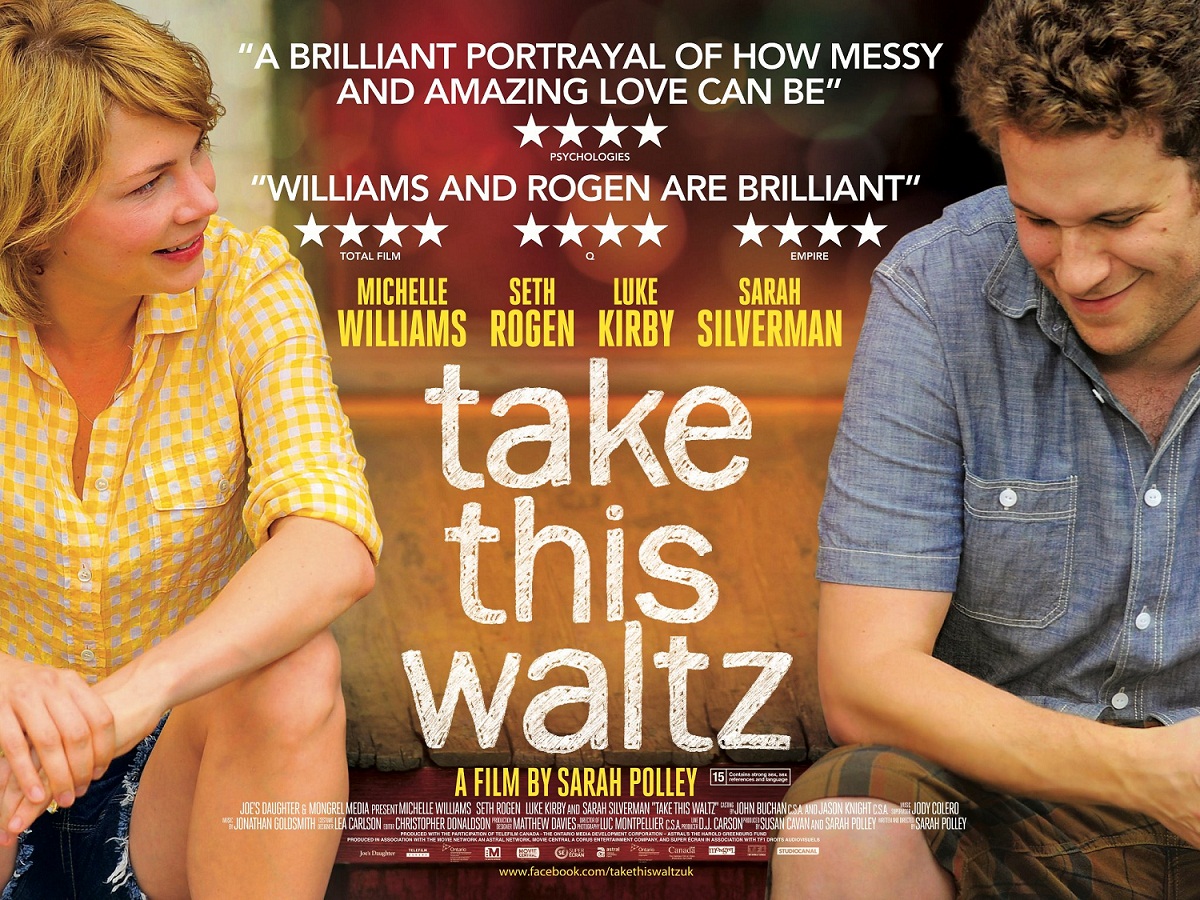
The Jacket Copy: Swelteringly hot, bright and colourful, Take This Waltz leads us, breathlessly, through the familiar but uncharted question of what long-term relationships do to love, sex and our images of ourselves. With a soundtrack that features both emerging independent bands and legendary songs by Leonard Cohen, it’s a funny, bittersweet tale of love. Director Sarah Polley (Away From Her) has created a sensual film, full of moments oscillating between joy and comedy and heartbreak.
My Take: This movie is dizzying in a deliciously life-like way, like how all your conversations go with your diary or most bosom friend, where you ping between decisions, guessing at possible outcomes, only for life to play out in a way you hadn’t quite expected. Okay, perhaps not all all your conversations, but your brain has been here. Mine has.
Michelle Williams was brilliantly cast, bringing a sweet innocence to the role, earning at least a little sympathy where another actor might not, given that she flirts with disaster (or courts her true destiny)–depending on how you interpret it. Tempted by the new, the different, by “other,” she entertains a possible life with another man, her new neighbor Daniel. While her silly but fiercely loyal husband works on his chicken cookbook, she steps out on a series of dates masquerading as non-dates.
As someone who has been married over six years, approaching seven-year-itch territory, I can confide to sharing a surprisingly new attitude toward the emotional adulterer: it’s not the end of the world, so long as no direct lies are told. It’s murky territory, for certain, but if Phil were to emotionally confide details of our life to another woman, an attractive woman, younger, more successful, complaining about me, I’d certainly forgive it. At least, I think I would. You don’t know how you’ll react to any scenario until you’re in it, I know, but my outlook has changed now that I’m closer to… death. Sorry to be grim, but I can’t help but think in extremes, in “You only live once.” Once things get physical, once you are betrayed with a lie, however, then it’s knife play in my world. Aside from endangering my health, lying is by far the worst offense.
As I watched, fully aware that Margot was “the villain,” I still found myself sympathetic to her point of view. I think it’s interesting, depending on your current life situation or the life scripts you’ve played out, with which character you side. I couldn’t help, though, believe that if Margot and Lou had children in this scenario how differently we’d judge the actions.
All in all, the film is big ambiguities, only questions; there are no answers. I think that’s why it’s such a bold film. The whole nudity (a shower scene of women at the gym/pool) bit isn’t what makes the film bold. It’s the ability to create a piece of art that raises questions, and so much like life, doesn’t answer them for you.
Such interesting quotes from the filmmaker, Sarah Polley:
“Buddhism that talked a lot about the concept of emptiness and about life having a gap in it, and what we do with that. And I think it was reading those books and starting to really be interested in that philosophy that made me want to make a film about that, about what we do with that gap we walk around with, and our need to fill it and to change up our life constantly to feel complete, and our constant failure to be able to achieve that.”
“I definitely wanted to make a film without heroes or villains, and I definitely wanted to make a film where the characters were as likeable as they were unlikeable, and that we could go back and forth on how we felt about them. So it was intentional for it to be ambiguous, it was intentional for it to leave us with more questions than answers, but I’ve been surprised how many people see it from one character’s point of view or another’s. I feel that people are really bringing their own relationships and past relationships to the film, and that’s why they’re so heavily invested in who they think is right and who they think is wrong.”
You can watch this film, streaming on Netflix or Amazon Prime (love the free shipping, has to be said). I’m a member of both, oddly, and yet I took this film home with me from my local library.

I also rented from library, couldn’t get through first hour! Boring and full of self absorbed characters. I’m in a great marriage for last 20 years.
This review sums up how I felt when I stumbled upon this movie on Netflix. Ambiguity and sympathy and understanding… I was expecting something different but was affected by what it was…
I liked this movie because of the visceral reactions some friends had. It shows you how we all cannot help but project our experiences on \to the problems of others. That said, a huge reason I caution against giving/taking advice w/intimate personal relationships. Especially that relationship is a marriage, I think advice should be measured with much more than a grain of salt. I think we are frightened of lulls in conversations *and* in relationships. Silence or moments of ‘quiet’ are seen as signs of trouble, boredom or irreconcilable difference. I notice that (married for 8 years, not long but long enough to know some peaks and valleys) the grass is greener’ syndrome can happen in dating and well as marriage. It can come without warning. It can come when you feel friends are experiencing more joy/more milestones in their lives. It’s human nature to compare, evaluate and critique. But how we navigate that, control that urge to hold up ourselves to others is what makes us unique.
This movie was subtle. I think not having a villian, having things in the gray zone makes people uneasy. We see some of ourselves in some scenes, some of our friends in others- and it makes us think. I loved this movie! Enough that I will see what else Sarah Polley produces::)
Saw this film a month or so ago via Netflix streaming. In discussion with my spouse, came to the conclusion that you can’t find happiness in someone else. All relationships become routine and you need to be happy within yourself.
Have yet to see this, but as a happily married woman (30 yrs this Sept) I agree with much of what c.c. wrote.
I do not agree about peaks, valleys, and silence. If that is happening in your marraige than you are not working at it. We dated 3 yrs before we were married, and waited 3 yrs to have kids, so those fun years were something we wanted to keep in our life. We never put our kids first. A priest once said during a sermon “you did not say until death do you part to your children”. So many marraiges I see disolve are because they make thier kids the whole reason for their relationship and then one day look at one another and say “who are you”. You have to be true to yourself, and true to your marriage. Kids are gone at my house, not empty next syndrome. It’s all about loving our time together, making new goals, and enjoying uninterupted snuggle time.